Showing posts with label Skwala. Show all posts

Saturday, April 20, 2013

Truckee River - Big and Small

Both big flies and small flies were catching fish today, as well as big people and small people, same went for the fish, some were big, some small.
This guy took a big Skwala
Next batter up took a little zebra midge
Little hands gripping a big fish

Dad was second late on snapping the shot
 What a day


Wednesday, April 10, 2013

Truckee River - Seine Ole Situation


Did some seining and fishing over the past week, way for me to get more hall passess...take the kids with me.
They seemed to love it, at least for the first hour.
One set of child waders, 3 boys, bad ratio
I learn as much as the kids when we do this and I'm always amazed at how many insects are floating by in any given stretch or water.
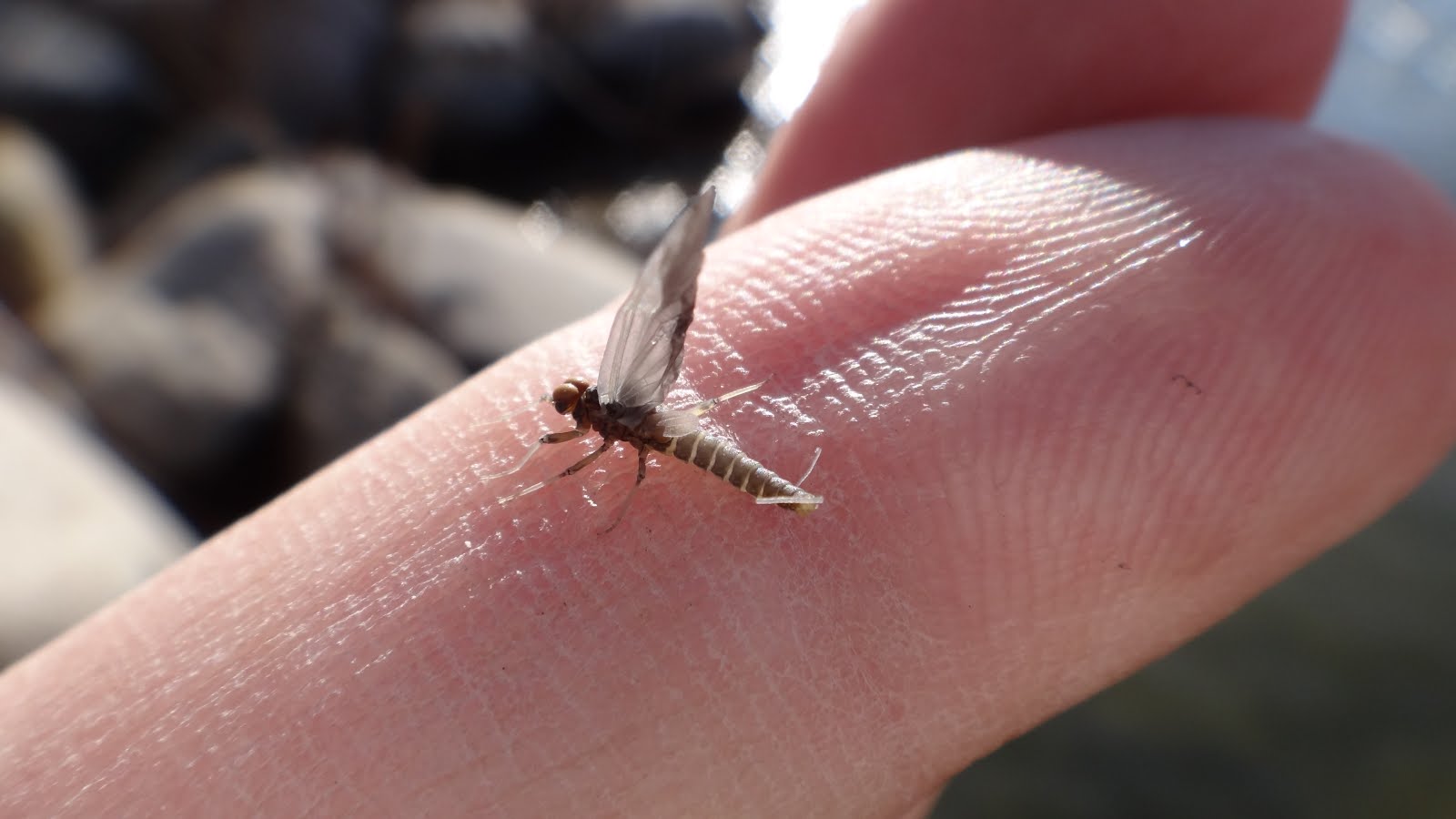
The seine sample was from about a week ago.  As usually, BWO's were the dominant mayfly, but I've noticed the hatch has waned since then, could be just about done.
 Letting the kids battle one or two fish always buys some more time before they get bored, and at their age, they always get bored.
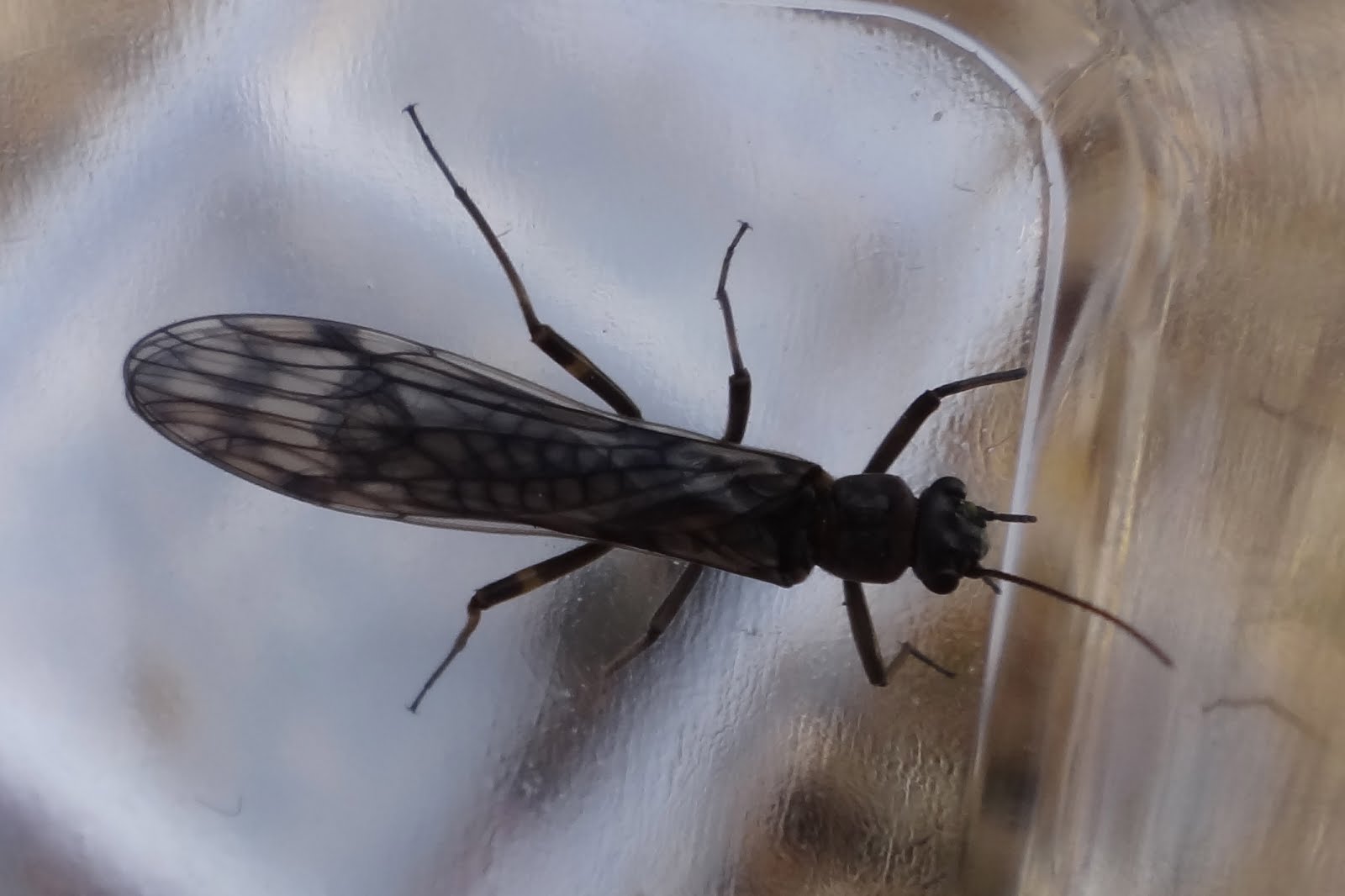
 Still seeing a few Skwalas out and about, but this too seems to be waning around Reno.


Saturday, March 23, 2013

Truckee River - Blue Wings


Today was all about Blue Wings, I did see some Skwalas but there is a crazy BWO hatch from 1-4.  Water got cold again since the last front so mid day is when fish are most active.   Check this guy out, almost pure cutty.  Damn reed, messed up my hero shot.


Check out One-Eye Willie, but don't feel too bad, he had no problem gorging on BWOs and had a pot belly to boot.

Sunday, March 3, 2013

Truckee River - Its Getting Buggy


Bugs are out in force on warm days like Saturday, low 60's for air tempt.  This hen is just full of eggs. We saw just about everything in good numbers from some sedges...
To a few Skawalas...
To hundreds of winter stones (size 18)
Oh, and don't forget march browns, the fish seemed to key into them the most.  
Dan ended up putting a hook with a barb through his hand this day, had to Bear Grill's it and push it through in order to pinch the barb, and then pull it back.

Monday, March 26, 2012

Pyramid to Reno


Fishing slowed a bit this Saturday. Despite some good winds late last week, Pyramid was miserably slow and that seemed to be the consensus for everyone we spoke to. Water is still only 44 degrees; it needs to warm about another 5 degrees for fish to start coming in from the depths.

Though flows were stable in the 500 cfs range, the Truckee, through Sparks and Reno, wasn't much better since the river blew out last week. Water is still off colored but fishable. DJ put one in the net and lost a nice one, other than that, just a few random grabs. The usual suspects (BWO and Skwalas) were out in good numbers as well as ever increasing numbers of caddis.

Sunday, March 18, 2012

Truckee River Entomology

This last week I've been working with my my eldest son on his 1st grade science project and what better topic to choose than Entomology...its a great basis for fly fishing. Not only is it educational, its something he really enjoyed (unlike when I take him fly fishing, he's bored if he doesn't have a fish in 5 minutes). This month is a great bug month, especially with the Truckee River flows being so constant...the one good thing about a lousy water year. This may be a bit basic for some of you avid river bums (after all, it was for a 1st grader), but I thought these seine net samples did a good job at showing a typical cross section of the abundant Truckee River invertebrate biomass.

As you'll see, I quote and link to many great sites from which I pulled much of our information. Lets start with the insects which undergo a complete metamorphosis (meaning their life cycle has 4 stages: egg, larva, pupa and adult):

Midges (includes animals in several families of Nematoceran Diptera; we looked at component family Chironomidae, aka non-biting midges)
To me, these two-winged flies are the most under-appreciated insect in the Truckee and especially in the Little Truckee. Its an important staple for trout in this area and carries fish over the lean winter periods because of its prolific numbers and year round hatches. When nothing seems to be hatching, I go midge'n. "In North America there are over two thousand species; in Britain there are at least 430; while there are over 600 species in mainland Europe; over 200 in Australia; and even more the world over. Where they are found, the midges form at least 50% of the aquatic insect population. In rivers midge can outnumber the 'mayflies' by as many as four times. Since the early part of 20th Century entomologists have gained a detailed understanding of these insects; knowledge which anglers have not ignored. The midge's lifecycle includes a full metamorphosis. Starting as eggs they hatch out as larvae and then have later phases as pupae and then adult." Above is a picture of an adult and a larva; they number in the thousands on any section of water on any given day.

Caddis (Order Trichoptera, we looked larvae of "free-living" Rhyacophila family including sedges and also found "saddle-cased" or Glossosoma family)
"Commonly known as caddisflies or sedge flies, number well over 7,000 worldwide. There are 1,200 in North America, 900 in Europe, and 640 in Australia. They represent a vast group occupying niches in both still and running water. Their greatest diversity is found in and around running water. Distinguishing the species of adult or larva is very difficult and usually impractical when waterside. This situation is not lost on an angler who will find several species present in significant numbers on any given body of water. Fortunately it is relatively easy to identify a caddisfly as belonging to one of five groups: Net-Spinners, Free-Living Caddis, Tube-Case Caddis, Saddle-Case Caddis, and Purse-Case Caddis. By briefly studying these groups we can later apply fishing strategies to match them." Above are images of a sedge adult and a green sedge larva. Caddis larva are tough to seine net, they hold firm to their homes and are easiest captured by flipping rocks.

Lets not forget those insects that go through an Incomplete Metamorphosis (meaning their life cycle has only 3 stages: egg, nymph and adult (dun [subimago] and spinner [imago]) - they don't create a Chrysalis in which to Pupate)

Mayfly (Insects of the order Ephemeroptera are commonly known as Upwinged Flies or Mayflies. We primarily found Blue Winged Olives, a type of Baetis and March Browns or Rhithrogena Morrisoni)
"After hatching, the nymphs feed on algae, plant debris, and other small food particles carried in the current. They grow through several instars before reaching maturity. This takes from a few months to a couple of years, once again depending on species and prevailing conditions, and also time of year when the eggs were laid." Above is a an adult BWO Dun, a mature BWO nymph with developed wing pads indicating its ready to hatch, a BWO husk (it hatched soon after we captured it in its nymph form) and finally a March Brown Nymph.

Stonefly (members of the insect order Plecoptera. We primarily found Skwalas and Winter Stoneflies.)
"The presence of stoneflies in a river or stream has always been a good indicator of a healthy aquatic environment. These members of the insect order Plecoptera are found in cool, well oxygenated flowing waters and occasionally along the wave-swept shoals of northern latitude lakes. Stoneflies have a worldwide distribution and thus are an important fish food source in both the larval (nymphal) and adult stages. Their life cycle which can include as many as 3 years in the larval stage is a significant reason why they are of such interest to fish. The larvae are benthic dwellers, crawling amongst the rock and rubble of the faster moving parts of the stream known as the riffle and run zones. Depending on the species, stonefly larvae can be herbivorous, omnivorous or carnivorous. Smaller aquatic invertebrates such as mayfly nymphs, dipteran larvae, algae and detritus are all common food sources of stonefly larvae." Above are images of stones caught in our seine net, a Skwala nymph, an adult Winter Stonefly and an adult Skwala Stonefly. Find, shallow oxygenated water to find these nymphs, they're great clingers but poor swimmers.


Some other items on the trout menu which we found include a couple of species of annelids (segmented aquatic worms) including this good sized leech which ended up eating the aquatic worm to the right.


Sunday, March 11, 2012

Truckee River March Update


Yesterday conditions were just about perfect for this time of year. Tons of BWO's and Skwala's hatching, and a stiff breeze knocked enough adults into the water that we saw a few fish smashing bugs on top. Flows on the NV side have been up the past couple of weekends to ~545 cfs due to higher flows coming out of the dams at Tahoe and Boca, but still, the water was in great shape.


Fish seem to be keying into either BWO's or Skwala's, depending on where you go. Some sections of water still don't have many Skwala's hatching yet; in those sections, BWO's are on the top of the menu. Fish can be found in slightly faster water than last month due to the warmer temps.


A few highlights:
Today we ran into the Western Regional Qualifier for the US Fly Fishing Team. This particular day of the event, 30 anglers were on various beats of the river throughout Reno trying to tally the most centimeters in a day. For the second part of the qualifier, they do the same on Pyramid Lake. We learned one guy got 600cm in one day on the Truckee, that's 240" between 11 fish for an AVERAGE length of 21.5" per fish! Out for 30 competitors, 6 will move on to the US National Fly Fishing Championships and possibly make the 'Fly Fishing Team USA' World Team. That's the team that would represent the US in the The World Fly Fishing Championships in Bohinjska Bistrica, Slovenia. It was a cool event to observe, though we did have to give way to competitors which were hitting some of our favorite runs...oh well, it was for a good cause.

Post mortem update: I got the real skinny from the guy in charge of the competition, the angler mentioned above who caught 11 fish...apparently the official count was 10 fish averaging 20" each, still an amazing haul!

Sunday, March 4, 2012

Truckee River - Like a Roll'n Stone


Two words for the Truckee today..."Stone Flies", and lots of em. Adult Skwalas were out in force and the fish were honing in on their nymphs. I cutoff my midge dropper and rigged up a double Skwala rig, hit some faster water and had some luck. I only landed a few smallish bows, but big brownies can't resist this T-Bone of the insect world.


Stones are not in the slow water, they're in fast running, oxygenated water, and fish feeding on them are in the same. I tested out my new switch rod today (idea for the setup courtesy of Gilligan) which was awesome. Roll casts send it out there and high sticking is actually possible for the hard-to-reach water.
Fellow contributor Dan and I attend the Fly Fishing Film Tour in downtown Reno. What a great event, sweet videos and lots of avid anglers that love fly fishing as much as us. It was a treat to meet many of the moguls of the Reno and Truckee fly fishing scene (including event coordinators Matt Heron and Dave Lass) and catch up with some old pals. This was the first one they've done in Reno and the turnout was excellent. I highly recommend going to next year's event, we'll post it when it comes up.