Showing posts with label Lahontan Cutthroat Trout. Show all posts

Friday, May 12, 2017

Trophy Trout - What Conditions Grow Big Fish?

Why does one watershed support only your average sized trout and the one a few miles over supports trophies? Why is that and what conditions need to exist to enable fish to grow big here but not there. I love fly fishing just to fish, even if I don't touch a thing, but I'd be outright lying if I told you i don't target large fish whenever I can. I don't purport to have all the answers but I have fished enough places and made enough observations to have some answers. Whether it be a high alpine lake in the Sierra's, the desert still waters of Northern Nevada or the arid wind swept steppes of Patagonia, one thing I've observed in most trophy trout fisheries I've encountered is relatively high alkalinity.
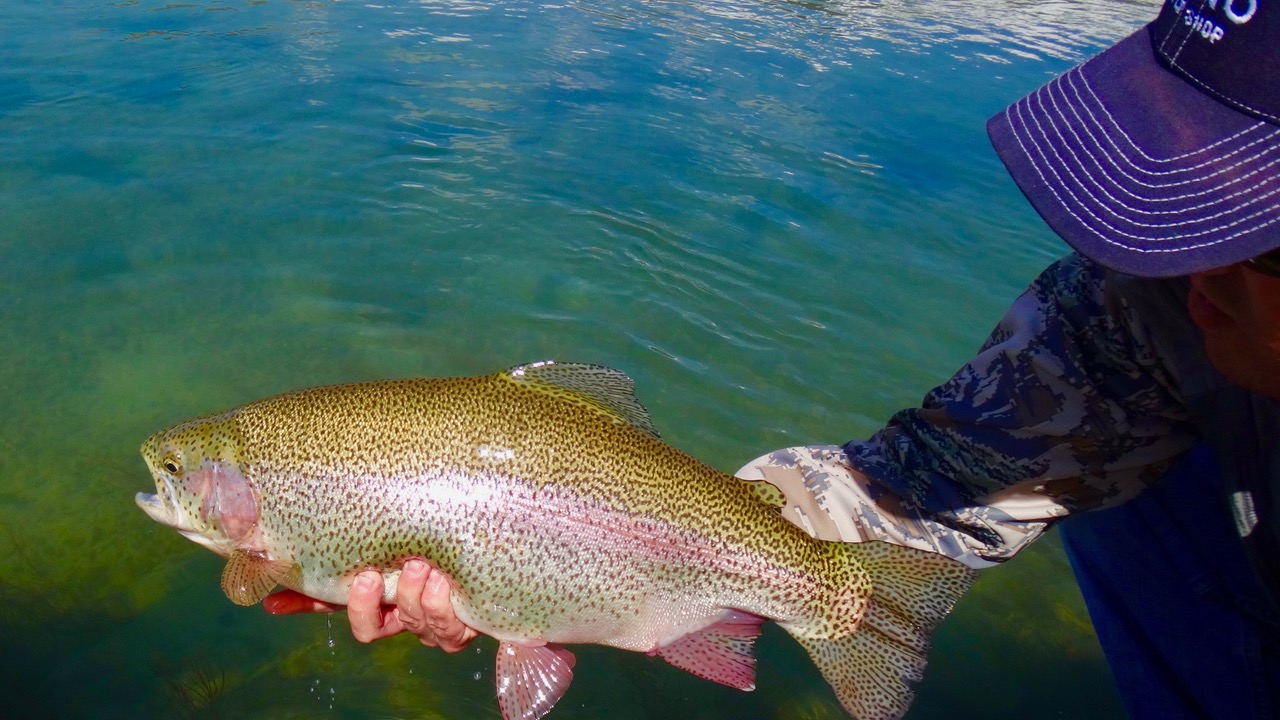
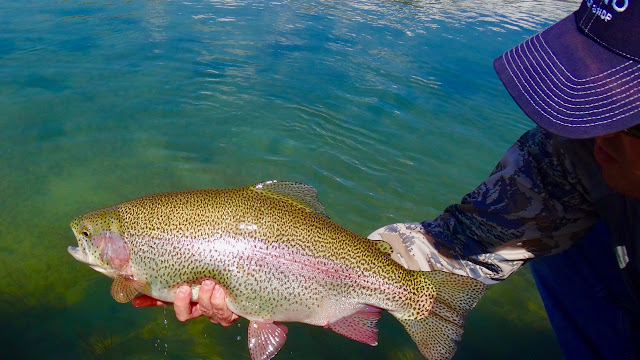
A Nevada rainbow obese from a strict scud diet. This picture was taken May 7th 2017, the picture below is the same fish on July 23rd 2016.  Theses are Tasmanian strain rainbow, originally a native Rainbow from Nevada, it was shipped to Tasmania in 1898 for fish farming.  After decades of  being bred in Australia it was brought back to Nevada.  Its one of my favorite strains of rainbow trout.
Same fish (matched by comparing spots on the lateral line, ventral fin and anal fin) 8.5 months earlier.  She put on an average of 3.8/oz per month through the leaner winter months, thats just under 3 pounds per year.

Without turning this into a chemistry dissertation, alkalinity is effectively a measure of a body of water's ability to neutralize acidic pollution. It is one of the best measures of the sensitivity of the stream or water body to acid inputs. A Ph of 7.0 is considered neutral, below that is acidic, above that is alkaline. Generally speaking, there is a direct correlation between alkalinity and water productivity. That relationship can be expressed in a formula, and I think it goes something like this: higher alkalinity = more microscopic photosynthetic items at the bottom of the food chain = more zooplankton = more trout forage (bait fish/insects) = more and larger trout.  Note, I'll steer clear of dissolved oxygen and water temperatures here, important factors for trout survival but not specific to trophy trout.
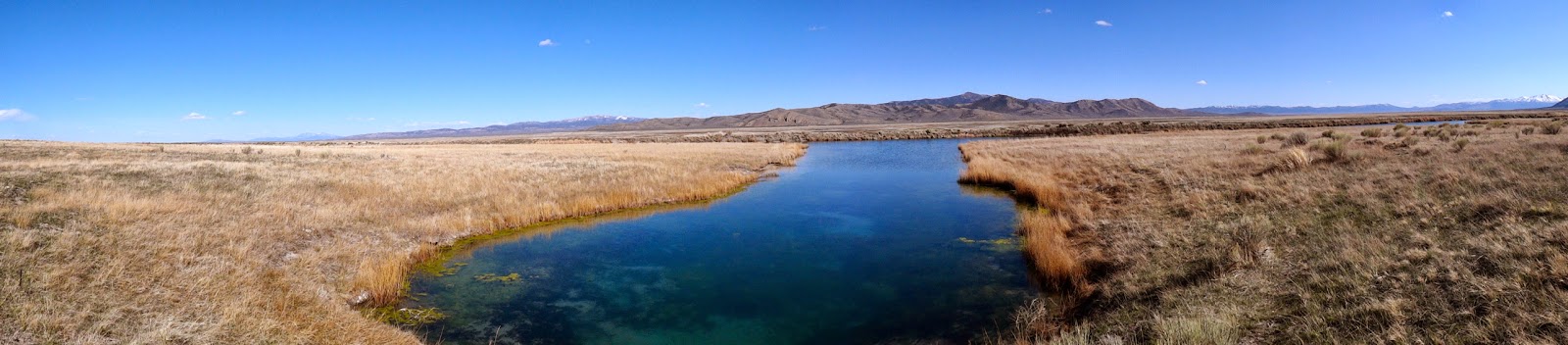
Scuds in an Alkaline Spring - scuds live about a year, gather like this about every other month to spawn and supposedly prefer low light conditions, although the later has not been my experience.
In Lake Tahoe, this formula may look something like this: low alkalinity = lower levels of phytoplankton = lower levels of zooplankton = smaller populations of forage fish, introduced mysis shrimp and invertebrates = fewer trout. Its not a knock, but Lake Tahoe is a big pristine granite catch basin and pretty unproductive relative to its water volume as are most high Sierra lakes. Notwithstanding introduced Lake Trout (Mackinaw) which are highly piscivorous - they are beneficiaries of being the apex predator at the top of the food chain.  Lake Trout in Tahoe may seam big but are they trophies? Our 37.6 pound state record is big relative to our other trout species in the state, but its by no means indicative of the true size potential of this fish. To find a true trophy, you'd have to join me (Aug 11-18th, 2018) on a trip to Great Bear Lake in the Northwest Territories Canada which provides a truly food-rich ecosystem allowing this species to reach its full size potential. The all tackle record of 72 pounds came from this lake, trophies are considered over 40 pounds.
Tui Chub, the prefer forage of Lahontan  Cutthroat Trout
By contrast, in Pyramid Lake the formula may look more like this: high alkalinity = higher levels of phytoplankton = higher levels of zooplankton = larger populations of Tui Chub = Plentiful and large LCT's. Fueled by a diet of Tui Chub, Pilot Peak strain Cutthroats fish can grow an impressive 4-6 inches and 4 pounds per year. Lastly, in Spring-fed Systems, you may see the relationship look like this: high alkalinity = high levels of phytoplankton & vascular elodea plants = high levels of amphipods (scuds) = plentiful and large trout. I've recorded trout putting on as much as 3.8 oz per month in alkaline spring waters, that equates to just under 3 pounds per year.  They almost exclusively eat scuds during the winter months and though they expand their menu to include aquatic insects and mice throughout the year, scuds can comprise 60% of their annual diet.
A Lahontan Cutthroat from Pyramid Lake Nevada.  After about 18" in length they become almost entirely piscivorous eating primarily Tui Chubs followed by juveniles of their own species. The clipped adipose fin give this fish away, its a Pilot Peak Strain. 
There is a point where alkalinity can be too high for trout, 6.5-8.5 is ideal for most trout, however, Pyramid lake has an unusually high Ph of 9.4.   This is lethal to all trout but the Lahontan Cutthroat Trout which has evolved in this unique terminal lake system. These inland terminal lakes have slowly receded over the millennia resulting in slowly increasing levels of dissolved solids including salinity and alkalinity. Alkalinity any higher that what it is now is even lethal for LCTs.  In addition to higher alkalinity, salinity can build in terminal lakes and affect trout too, just look to the east at another terminal lake, the Great Salt Lake.  The Bonneville Cutthroat Trout can no longer tolerate its salty waters. The high alkalinity in Pyramid Lake forms a natural barrier agains't other trout species for the lake fish in as much as it prevents intermingling of the Lahontan Cutthroat with Rainbow Trout which are present in the Truckee River. This barrier, however, isn't present in the river itself where trout spawn, hence authorities have been resistant to allowing LCT's past Marble Bluff damn where hybridization is possible in the Truckee River.
Argentinian (Patagonian) Rainbows grow to gargantuan proportions in a lake devoid of all forage fish due solely to its alkaline water and prolific scud populations. This particular strain is a McCloud River Rainbow (yes, transplanted from California to S. America in the 1990's).  This fish is large due to a nearby alkali terminal lake, they're only in the river briefly to spawn. 
Other Considerations for Trophy Trout (Other than Food):

  • Definitional Considerations - Only you can define a trophy - is it only a big fish? I caught 30" Lahontan Cutthroat under an indicator the other day after work within 100 feet of my truck out at Pyramid, another time I caught a 16" golden on a multi-week trip at ice-out in a stream at 12,000 feet. To me, the former was not a trophy, but the later was. Generally.  In my personal equation, I consider the relative size and number of large fish, while also factoring in the difficulty to cast to, fool and ultimately land the fish.  Back to relativity, a creek trophy is not comparable to a river trophy is not comparable to a lake trophy, etc.  Back to difficulty, a fish caught on an egg pattern in the Rio Barranocoso is not comparable to one fooled on a dry in the Little Truckee's 610 pool - a mouthbreather could do the first, the later requires a patient and skilled tactician.  There is no universal  definition of what makes a trophy in my book.
  • Water Body Considerations - As a rule of thumb, lakes typically have more forage and habitat and generally speaking, can accommodate larger numbers of larger fish. Don't get me wrong, rivers like the big Truckee can house resident trophies too (plus I prefer fishing them over lakes). But in the Little Truckee for example, the resident browns seldom exceed 20", however the migratory lake browns and Mackinaw coming out of Boca can exceed 30". Fish often grow quicker in lakes, so it goes without saying that rivers going into/out of lakes will often have larger fish (on average). I've spent a lot of time on the Naknek River in Alaska, touted as north America's premier rainbow trout fishery boasting some of the largest non-steelhead rainbows in North America.  These trout don't get that big by living in the river alone, true there's literally tons of roe and smolt to fatten the up on for 4 months of the year, but they also grow large because during the other 8 months of the year they have a massive lake to continue feeding in. Same goes for the Wood and Williamson Rivers in Oregon, were it not for Klamath and Agency Lakes, you won't see the monsters they're famous for. At the risk of belaboring the point, the Tree River in Nunavek Canada has a run of the world's largest Arctic Char eclipsing 30 pounds.  That trip is coming up next year, but the reason for the big char is the big body of water at the terminus of the river the fish are able to grow up in - that body of water being the Arctic Ocean.  The resident river char rarely exceed 4 pounds. Another water consideration, big fish need cover to get big. Deeper waters, structure, and riffles which camouflage their silhouette all provide cover - cover from predators, cover to ambush prey, and cover to avoid anglers. This cover promotes larger fish.  Lastly, lakes (and streams for that matter) with large littoral zones (shallow, weedy shorelines where photosynthesis can occur) can be prime trout growing habitat.  Craine prairie reservoir in Oregon is one massive littoral zone which is why it pumps out huge fish (off traditional aquatic insects no less).
  • Species Consideration - Golden Trout have evolved in high alpine lakes/streams which have limited aquatic/terrestrial invertebrate food sources and short growing seasons, so they've genetically evolved to thrive in these harsh conditions by developing smaller frames which require fewer calories to survive and procreate. That said, if you want to target trophy goldens, the same fundamentals apply. Find alkaline waters, particularly with scuds. In 1996 I hiked the John Muir Trail and completed several cross country loops (6-weeks, +300 miles, 72 lakes, 150 streams). I painstakingly documented all my catches.   Hands down, the largest "trophy" goldens were in just 3 of the most remote lakes, each lake having higher levels of alkalinity and a substantial scud population (a rarity in the high Sierras). Its no coincident that the 9.5 pound California state record golden came from one of these lakes. By contrast, Pilot Peak strain Lahontan Cutthroat Trout (Pyramid's original strain) have evolved to be piscivorous apex predators in terminal alkali lakes which boast huge numbers of Tui Chub. Pyramid Lake is believed to have approx. 500,000 Lahontan Cutthroat Trout, and there are estimated to be 100 Tui Chub per trout or 50,000,000 chub. Now that's protein. Fishing for Pilot Peak strain LCT's in Pyramid will yield much bigger fish than indigenous LCTs in Summit Lake (the home of a cousin strain of LCT) a much smaller isolated lake where the fish have evolved to primarily subsist off of scuds. They're also going to be bigger than indigenous LCT's in Independence Lake, a less alkaline lake with respectable but lower productivity situated in a high-altitude granite catch basin which freezes over in the winter. 
  • Growing Season - Water systems that freeze don't offer much forage in the winter, and while those that don't freeze often have insects which hatch out year around, and while your typical aquatic insects (midges, caddis, mayflies & stoneflies) do a good job of sustaining fish during the winter, they usually don't lead to substantial growth during these lean months. Having a large year round calorie source is key, and alkaline lakes which produce huge populations of forage fish and scuds allow fish to actually pack on weight every month of the year, with or without ice. I can't leave out this formula either: Tailwater's = year-round growing season. Tailwater fisheries (rivers regulated by dams) don't freeze in the winter and typically have stable year-round temperatures. For instance, water coming out of the Stampeded Reservoir in CA is usually 45 degrees in both the winter and summer, perfect for trout all year. Stable year-round flows and temperatures promotes a year-round growing season.  Such is the case with Colorado's Frying Pan River which produces monster trout year round.   
  • Invasive Species - You can have all the right conditions resulting in high levels of productivity but still not have a trophy fishery if the water system has been taken over by invasive species. Northern Pike at one time ruined the trout fishery at Davis Lake in California and Large Mouth Bass have really taken their toll on rainbow fishery at Craine Prairie Reservoir in Oregon. Not only do they feed on the same forage as trout, juvenile trout are on their menu. 
  • Competing Species - Particularly for high country alpine lakes, avoid brook trout. I know they're pretty but they're not very compatible with trophy fishing. They are capable of spawning even without a flowing tributary and are prolific breeders. They can quickly over populate a lake and outstrip its food sources.  The result is a lake with hundreds of brook trout with large heads and skinny, malnourished bodies. If you're targeting trophy brook trout, same principals above apply, find alkaline lakes with scuds.  They didn't really evolve in high altitude lakes so you may target lakes at more moderate altitudes, Kirman Lake in California has some trophies in it (on my list of places I still need to explore). 
  • Water Quality and Quantity - Rapid changes of water levels, particularly in tailwater fisheries, ravages populations of aquatic insects, forage fish and scuds which translates into less food to grow large trout. Additionally, as it the case with Pyramid Lake, the diversion of the Truckee River's fresh snow-melt waters to Fernley, NV (occurring at Derby Dam) has altered the chemistry of the lake. Being a terminal lake, water leaves Pyramid in one of two ways, through evaporation or percolation. The diversion of approximately 50% of the Truckee's incoming fresh water annually has resulted in the lake receding approx. 100 feet over the past century (average of 1 foot per year since 1905). Instead of being 450 feet deep, the lake is now only 350 deep, a 28% decline in linear depth, but in terms of volume, its likely more than a 40% decline in total water volume. Now then, dissolved solids can't leave the lake through either evaporation or percolation so these solids are now more concentrated in the lower volume of water resulting in changes to lake's chemistry. Over the past century, newly altered levels of alkalinity, salinity and other dissolved solid has occurred faster than evolution can keep up is likely preventing fish from reaching their full size potential because of reduced lifespan. If fish need to live 12 years to reach 40 or 60 pounds, but are only living 5 or 6 years, they won't reach their full trophy potential. I have no doubt this explains why a 24-pound Lahontan Cutthroat stocked in 2007 was caught in November 2012, and since then, in the past five years, despite becoming ever more popular and heavily fished, nobody has cracked 30 pounds. I'm not saying fish that size don't exist, a handful may, but I'm saying the fish are limiting out and reaching the mid to high twenties at year 5 or 6 years and then dying. The good news is that the massive inflow of water from the Truckee this year (2017) is raising the lake approx. 5 to 8 feet and should serve to dilute the water and hopefully help rebalance the chemistry a little. Further, several years of silt, nutrients and detritus from the drought years have been washed into the lake by flood-level waters and should result in higher levels of phytoplankton, larger schools of Tui Chub, and (fingers crossed) Lahontan Cutthroat Trout Eclipsing 30-pounds by 2020 (that is my prediction).  I'm being mindful that 2011 and 2012 saw no Pilot Peak strain fish stocked at Pyramid, so if they're dying when I think they are, 2016-2018 will have a lull of big fish, hence my 2020 prediction.
Ed Smiths 36", 24pound LCT caught in November 2012. The fish was stocked in 2007. 
  • Regulations - I debated throwing this in, but at the risk of stating the obvious, catch and release fisheries tend to promote larger specimens, but not always. Catch and release Blue Ribbon streams such as Rock Creek in Montana have 10,000 trout per mile (a common attribute of Blue Ribbon waters) but good luck finding something over 15". By contrast, the Truckee River has between 1,000 and 3,500 fish per mile and you can find nice healthy trophies throughout. Also, although the CA side of the Truckee is largely managed as a catch and release fishery and the NV side is managed as a put and take fishery, most anglers agree there are more trophy fish on the NV side, so food and/or water considerations can trump regulation. 
  • Spawning - There are two ways this can come into play, first, fish that spawn are occupied fattening up, producing eggs/milt, and spawning/fighting for a very big portion of the growing season.  While is normal and natural, its also something to be aware of.  Fish that are alternate year spawners (i.e. Pilot Peak strain LCTs) and triploids (sterile fish) have less demands on them caused by spawning and therefore more time to pack on the pounds.  Secondly, resident trout which inhabit waters with large populations of migratory spawning trout or salmon can grow larger as a result. Trout often times key into spawning cycles, for instance, rainbows will follow browns up in the fall to gorge on their roe, browns will do the same to rainbows.  Also, browns and Mackinaws will follow up Kokanee in October to eat their roe and even the fish itself (the Kokanee in/around Tahoe/Truckee are of the stunted high altitude variety, are are bite sized for mature trout).  These are unique times of the year where large lake dwelling fish occupy streams/rivers otherwise to small to sustain them year round.  In the Ushigak Narrows in Alaska, thousands of starving Arctic Char pile in on a 400-yard stretch of river between the two lakes to descend on Silver Salmon roe, in June the char emaciated, but after 2 months of gorging on protein-rich roe, they're bursting at the seems, more than doubling their pre-spawn mass.
  • Pressure - Another obvious one, but if you can drive right up to it, high chance trophies (if they're still there) are well educated with PhD's in fly avoidance. Get off the beaten back, hike in, sometimes you need to work hard to find that secret section of river, the one that's a mile from a turnout off on I-80, or that piece of water that may only see a handful of anglers in a given year. Exploration and finding new water is a huge part of the experience so get out there and find your trophy!  
In summary, food source is the single most important factor in finding large fish, and alkalinity is closely correlated to food productivity. Additionally, food and alkalinity is so important, I feel it can trump many if not all of the other considerations I've mentioned, so keep that in mind as well.

Hope you enjoyed my medley of opinion and fact, feel free to leave a comment.


Monday, February 22, 2016

Pyramid Lake - February Update

Its still hit and miss out there at Pyramid, being in the right place at the right time matters, stick and move if you're striking out or wait for that school to come in, they usually do once or twice throughout the day.  Some big fish are being caught, supposedly a confirmed 27 pounder and an unconfirmed of the same size.  This may be the year of the 30 pounder, they say its overdue. April is almost here!


Sunday, April 19, 2015

Truckee and Pyramid Update

Truckee flows look like they're coming down already, they just dropped flows out of Boca which had been the source of the preponderance of the River's water, hope its not the beginning of the end of good flows, but there isn't a whole lot more that reservoir can give, it didn't recharge much this winter.  This may be the year to try other waters, the Truckee is going to be a creek soon.  Good BWO activity and March browns still can be found, fish holding on the seams and edges of riffles. 
When flows rise and the water muddies, annelid patterns get attention.
At Pyramid, if there isn't wind, don't even bother.

 Birds = chub = fish...usually.  A little wind chop makes all the difference.  First light had some large cruisers, but we only had takes from a few fish in the 2-5lb range for the first hour after sunrise, then lock jaw set in.  Stripping martinis produced over nymphing.
Feisty Pilot Peak Strain
 Get there before the sun comes up if you want a slot, I personally prefer remote beaches, even if there aren't as many fish.  When the fishing slowed, I watched schools of fish pass anglers at Pelican Point without the slightest interest in what they were tossing at them.  It was comical to watch two pairs of fish attempting to spawn between some of the anglers and the shoreline in less than 2 feet of water
.
 Watch for wind and then get out there, the Summit Lake strain of Lahontans are in full spawn mode but the Pilot Peakers are supposed to get in the mood little later, so they should still be in feed mode.


Sunday, April 12, 2015

Pyramid - The Wind is your Friend

Not only does it run half the other anglers off the water, but it brings the fish in to ambush prey.  Couldn't find a leeward beach so a windward one had to do. 
Its a hurricane over at the Pinnacles, when this happens, get off the water and fish from shore.
They seemed to be taking nymphs and streamers interchangeably.

 Ever seen this off to your east on the way from the reservation to Gerlach?  Had to check it out, wonder what it was, miners, Indians?  Who knows.
 Can't be super old, they had mortar, saws and plate steel (riveted, not welded).

Wednesday, June 18, 2014

Incline Lake - A potential local Lahontan Cutthroat Trout Fishery?


Some of you may remember fishing Incline Lake (aka Little Lake), formerly owned by the Incline Lake Corp. which was little more than a collection of locals who wanted a nearby private retreat. Above is an aerial photo from 2006 when the lake had water.  Situated at an 8,300ft elevation and only one mile west of Mt Rose Ski Resort (Slide Mountain), it is secluded and private and you used to have to be invited by an owner to fish it.  What a great little fishery, feisty little brookies and nice fat bows 2-5 pounds with some fish growing well in excess.  The lake was full of forage fish that kept the trout fat and healthy.  The 33-acre lake is now at a crossroads.  In 2009 it, along with 777 adjacent acres of forest, was purchased by the Forest Service for the bargain price to the public of $43.5 Million, of which ~$5.5 Million was appropriated for rebuilding the damn.  Part of the "official" rationale for the purchase was to make it a public fishery, but per inquiries with former owners, I've surmise that the real impetus came from powers in Tahoe intent on preventing further development of this grandfathered real estate.  In any event, the lake has since been drained and the damn could (and in my humble opinion should) be repaired, but there is talk now about restoring it to natural meadowlands. The public was invited to weigh in recently but unfortunately the public comment period closed June 6th.  

High Sierra Fly Casters has a good article that explains the situation, unfortunately, I just became aware of the role we (the public) could play a few days too late.  Here is a link to the aforementioned article, A Lake is a Lake, Until it Isn't.  If the Forest Service decides to rebuild the damn, the plan is to  possibly plant the lake with Lahontan Cutthroat Trout - wonder if they'd put in Pilot Peakers.  It would be awesome to have a new alpine fishery only 30 minutes from Reno.

Below is an aerial photo from 2010, the lake looks like this today, dry.  I'm hopeful (fingers crossed) they decide to repair the 70+ year old dam and restore this awesome fishery.
 If anyone has intel on the situation, love to hear it.

Tuesday, April 15, 2014

Fly Fishing Northern Nevada - The Trifecta

1 Angler, 2 Days of Fishing, 3 Bodies of Water, 4 Species of Trout.....High 5.  I had the pleasure to fish what I feel are Northern Nevada's three best fisheries in a recent spur of the moment outing.  22 hours of fishing in 2 days amongst the most beautiful bodies of water the Battle Born State has to offer.  Midges, BWOs, caddis, streamers...they all worked, but midges followed by BWOs took the day for all three waters.  A Tasmanian Rainbow below, speckles protrude well below the lateral line.
Fish were best measure by the pound.
 Magnificent Colors
Bows and a Tiger Trout stacked up and doing anything but feeding
 Bring your A game to nymph these super clear spring heads
 A healthy post spawn cutbow
Morbid obesity is the number two cause of death amongst trout....ok bullshit.
 Browns are rare in one location I was at....getting two back to back was a treat.
Super ladder and a Pyramid Lake sunrise
A little Lahontan Cutthroat, monsters are alluding me this year, you have to put in your time and I don't.


The Truckee River entering Pyramid Lake
A feisty rainbow from the Truckee River in the brown waters east of town to finish it off


Wednesday, March 12, 2014

Off Roading in Nevada - The Tungsten Workings of the Nightingale Mining District, Nevada

This off road adventure up Coyote Canyon allowed us to step back in time and visit our native and mining pasts.  It started out as just a way to get out with the boys and see some country you can only access with a worthy off road rig and a good map.  The trip far exceeded our expectations and won't soon be forgot.  Forgive the picture-rich post which has nothing to do with fly fishing, but this winter's fly fishing has been a drought (pun intended) and I couldn't help myself.

The trek began early one Sunday morning in Reno, then east towards Wadsworth, north through the Pyramid Paiute Reservation and the budding metropolis of Nixon, then northeast through old mining roads and canyon washes until you reach the eastern slopes of the Nightingale Range near the intersection of Washoe, Pershing and Churchill Counties.  

As you leave Nixon bearing north east, you'll parallel a ravine which appears to have held a substantial water supply at one point.  This ravine (pictured below) would be the pre-Derby Dam terminal arm of the Truckee River which supplied Winnemucca Lake with its life blood....water.  Before Derby Dam diverted water from Pyramid Lake, it was approximately 100 feet higher and overflowed its banks creating another 6.5 mile section of the Truckee River which fed Lake Winnemucca.  Derby Dam was built in 1903, the aforementioned arm of the Truckee stopped flowing soon thereafter and the lake was dry by 1939.  Its hard to believe that only 120 years ago, Paiutes used to stand on the river banks and harpoon fish as they migrated between the two lakes.  Additionally, the Paiutes hunted migratory water fowl that used the former lake for food and refuge.  Following the lake's demise, the migratory path of the waterfowl shifted to the north.  

 Would you ever know gazing upon this expansive desert playa (below) that less than 90 years ago it was a 100-foot deep terminal lake teaming with wildlife and supporting Indians along its shoreline?
 There are extensive Tufa rock formations which border both Pyramid Lake and Lake Winnemucca's shorelines.  Tufa is a porous variety of limestone that generally forms along lake shores.  You'll find Tufa throughout the Great Basin in the footprint of Ancient Lake Lahontan.  Paiutes inhabited many of the caves which abut its peripheries.  Below we found a set of caves which appeared likely to have been used as shelters thousands of years ago.
Below, soot from fires appears to have coated the Tufa pillows in this particular cave which adjoined the shoreline of former Lake Winnemucca less than a century ago.
Perched high on the mountain, an smaller cave sits above the first which also appeared to bear the signs of ancient fires.  Though we were on its eastern shores, the petroglyphs on the western reaches of Lake Winnemucca date back from between nearly 11,000 and nearly 15,000 years ago and are widely considered the oldest petroglyphs in North America.

Coyote Canyon trail often takes the form a seasonal wash.
Below are the lower workings of the Jaybird Tungsten Mine.  This adit was through pretty solid granite which was not fragile like shale or limestone workings.  A floor void of debris and an adit w/o the need for cribbings for support gave me confidence to take a quick peek inside.  Watch for the black damp, generally not a concern near a portal (I don't have a death wish and I didn't go that deep).
A stope braced with large juniper logs...where did those come from, the Nightingale Range is devoid of timber.
Good to see some guzzlers full of water in a dry year like this.


An old mining cabin at the Nightingale Mine, partially buried...I suppose for insulation?

The Nightingale Mine was the biggest tungsten producer in the district.  Its massive workings and tunnels follow a vein of limestone and shale which abut a layer of granite.
Below is a winch frame atop a deep shaft.

I believe this mill was built by the Gold-Silver-Tungsten Co, Inc. and was designed to handle 100 tons of ore/day but saw very little use.  Mining companies often times got ahead of themselves and built infrastructure that wouldn't always be supported by the minerals in the area.
A flat bed of sorts, looked like it was part of a wagon but who knows.
Here you can appreciate the size the the limestone vein which was mined as far as 128 feet down.  These open stopes continue for approximately 1,600 feet (north to south).
Portals like this dot the hills.

A road less traveled.
Either the beginnings of a shaft near High Grade Mine or one which outlived its usefulness and collapsed
High Grade Mine Cabin
Needs a little TLC
Smoke shack?  Storage/cellar?  Can't figure it out, it had a stove flue in it, but was too small to house people...anyone know what it is?
Finally something they can check out.
Below is the upper MGL Mine Canyon, I don't know its real name but it hides a "secret" mine on the upper western slope (the road to the right).
I wouldn't have stumbled across this mine were it not for Google Earth.  You wouldn't expect a mine to be here...you wouldn't expect anything to be here.
TNT was stored here years ago.
Away from anything which could set it off.
Not sure what this cabin was use for, it was on the same grade as the ore bin seen toppled to the right.
Another shot of the ore bin.
16" pipe?  Where did they get the water to necessitate such a massive diameter pipe?  What did they do with the water?  Was this used to power a monitor to strip the hillside?  There are a couple meager springs nearby....that's it.
Okay, this is the type of mine that doesn't give you a good vibe.  Fractured limestone, unstable everything and collapsed cribbings to the right. 
A quick picture of this crazy timber framing that goes up 3 levels and down as far as light will let you see.  Time to get the "@#$%" out and view from a safe distance above.
Even outside of the mine you need to be mindful of where you step.  most dangers lurk above the main portals where stopes and air shafts inconspicuously protrude through the surface.  
Here you can appreciate the magnitude of the workings and just how hopelessly screwed you'd be should you fall into them.  You also have to ponder the skill, labor and dedication required to mine this back in the 1920's and 1930's.
This ladder is probably 15 or 16 feet long, compare that close up to the picture above.
60 or 70 feet of sheer vert.
An unmarked hole atop the upper workings....the ground you see below is a good 70 feet down.
6 foot human as scale (well, 5'10, but don't tell him that).
If you look close, you can see a winze and what appears to be a head frame for the main vertical lift.
Stay back, stay far back!
Ah, my keys, so close yet so far away.  Got to love the auto-lock technology on these new vehicles.
Hurts a bit...new truck.
The deed is done.
The Arch....We Found It!!!  Was a complete accident on a wild goose chase for a mine that wasn't even a mine.
Goofy picts never get old.
One last Indian Cave on the way out, the backdrop is amazing.